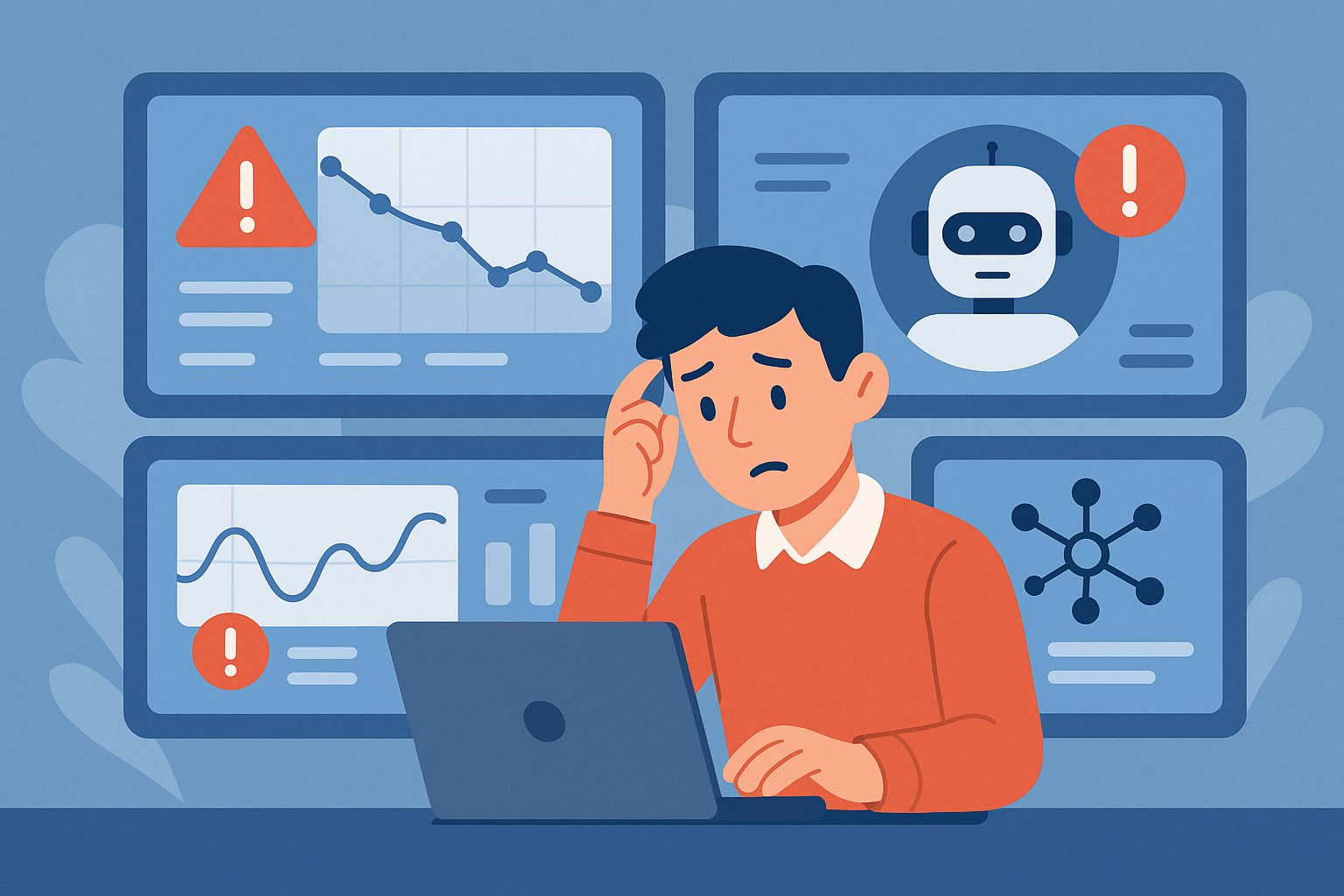
AI automation does not always fail in dramatic ways. Sometimes it keeps running while quietly producing weaker results, missing edge cases, or increasing hidden operational risk. That kind of failure is especially dangerous because teams often notice it only after trust is already damaged.
1) Output Quality Drifts Without Obvious Errors
One of the first warning signs is that the system still appears healthy, but the work product slowly gets worse. Summaries become less precise, extracted data needs more cleanup, or drafted responses sound less helpful. Because nothing is crashing, these issues can hide in plain sight.
This is why quality sampling matters. If no one reviews real outputs regularly, gradual decline can continue for weeks before anyone recognizes the pattern.
2) Human Overrides Start Increasing
When operators begin correcting the system more often, that is a signal. Even if those corrections are small, the rising override rate often means the automation is no longer saving as much time as expected.
Teams should track override frequency the same way they track uptime. A stable system is not just available. It is useful without constant repair.
3) Latency and Cost Rise Together
If response time gets slower while costs climb, there is usually an underlying design issue. It may be unnecessary tool calls, bloated prompts, weak routing logic, or too much reliance on large models for simple tasks.
That combination often appears before an obvious outage. Watching cost and latency together gives a much clearer picture than either metric alone.
4) Edge Cases Get Handled Inconsistently
A healthy automation system should fail in understandable ways. If the same unusual input sometimes works and sometimes breaks, the workflow is probably more brittle than it looks.
Inconsistency is often a warning that the prompt, retrieval, or tool orchestration is under-specified. It usually means the system needs clearer guardrails, not just more model power.
5) Teams Stop Trusting the System
Once users start saying they need to double-check everything, the system has already crossed into a danger zone. Trust is expensive to rebuild. Even a technically functional workflow can become operationally useless if nobody believes it anymore.
That is why AI reliability should be measured in business confidence as well as raw task completion.
Final Takeaway
Quiet failures are often more damaging than loud ones. The best defense is not blind optimism. It is regular review, clear metrics, and fast correction loops before small problems become normal behavior.