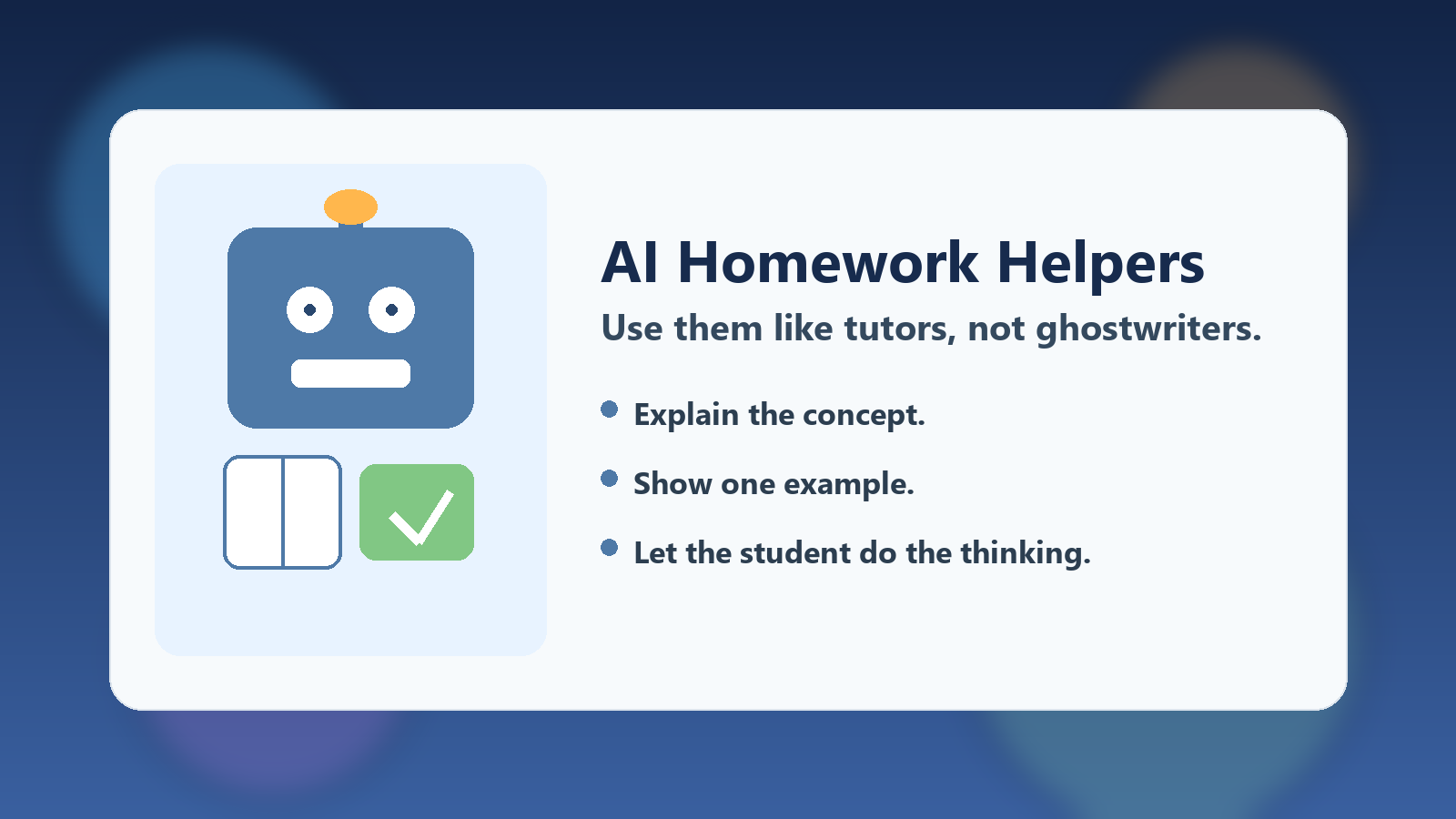
AI homework tools are getting better fast, and that makes them both useful and risky. Used well, they can help students brainstorm, explain hard concepts, and check understanding. Used badly, they can turn into answer machines that short-circuit learning.
The practical goal is not to ban these tools or hand them unlimited control. It is to build a routine where AI supports thinking instead of replacing it. Families that set clear expectations early usually have a much easier time later.
Start With AI as a Tutor, Not a Ghostwriter
The healthiest default is to treat AI like a patient tutor. A tutor can explain a math step, suggest a better outline, or ask follow-up questions. A tutor should not quietly complete the assignment and disappear.
That distinction matters because students learn through struggle, revision, and reflection. If the tool produces polished work too early, the student may get the grade without gaining the skill.
Use Better Prompts That Force Understanding
Many of the worst outcomes come from vague prompts like “write my essay” or “give me the answer.” Families can improve the experience immediately by encouraging prompts that ask for explanation rather than completion.
- Explain this concept in simpler words.
- Show me one example, then let me try the next one myself.
- Point out what is weak in my draft without rewriting the whole thing.
- Ask me three questions that test whether I really understand the chapter.
Those prompt patterns keep the student in the loop. They also make it easier for a parent or teacher to see whether the tool is strengthening comprehension or just generating output.
Set a Simple Family Rule for Drafting
A good household rule is that the student creates the first real input. That might be an outline, a rough paragraph, a set of notes, or an attempted solution. After that, AI can help improve clarity, organize ideas, or identify mistakes.
This rule is useful because it preserves ownership. The assignment still starts with the student’s thinking, which makes the final result more honest and much more educational.
Watch for the Warning Signs of Overuse
Parents do not need to monitor every prompt, but a few signals are worth noticing. If a student cannot explain their own answer, suddenly writes in a voice that does not sound like them, or becomes dependent on AI for every small step, the tool is probably doing too much.
The fix is usually not punishment. It is narrowing the allowed use. Move back to explanation, quizzing, and feedback until the student can show independent understanding again.
Teach Verification Alongside Convenience
AI systems still make mistakes, invent facts, and present weak reasoning with too much confidence. That means students should learn a second habit at the same time they learn prompting: verify important claims.
For homework, that can mean checking textbook pages, class notes, teacher instructions, or reputable reference sources before trusting a polished answer. This habit matters beyond school because it trains digital judgment, not just tool usage.
Final Takeaway
AI homework helpers are not automatically good or bad. They are leverage. In a family with clear boundaries, they can make learning less frustrating and more interactive. Without boundaries, they can make students look capable while quietly weakening real understanding.
The best approach is simple: let AI explain, question, and coach, but keep the student responsible for the thinking.