Blog

  • Cloud Governance That Scales: 7 Rules Practical Teams Follow

    Cloud Governance That Scales: 7 Rules Practical Teams Follow

    Cloud governance works best when it is boring, consistent, and hard to bypass. The strongest teams focus on repeatable rules instead of heroic cleanup efforts.

    Seven Practical Rules

    • Every resource needs an owner
    • Tagging is enforced, not suggested
    • Budgets are visible by team
    • Identity is reviewed regularly
    • Logging has named responders
    • Policies are versioned
    • Exceptions expire automatically

    Why This Matters

    Governance is what turns a growing cloud estate into an operating system instead of a pile of subscriptions and surprises.

  • Azure AI Foundry vs Open Source Stacks: Which Path Fits Better in 2026?

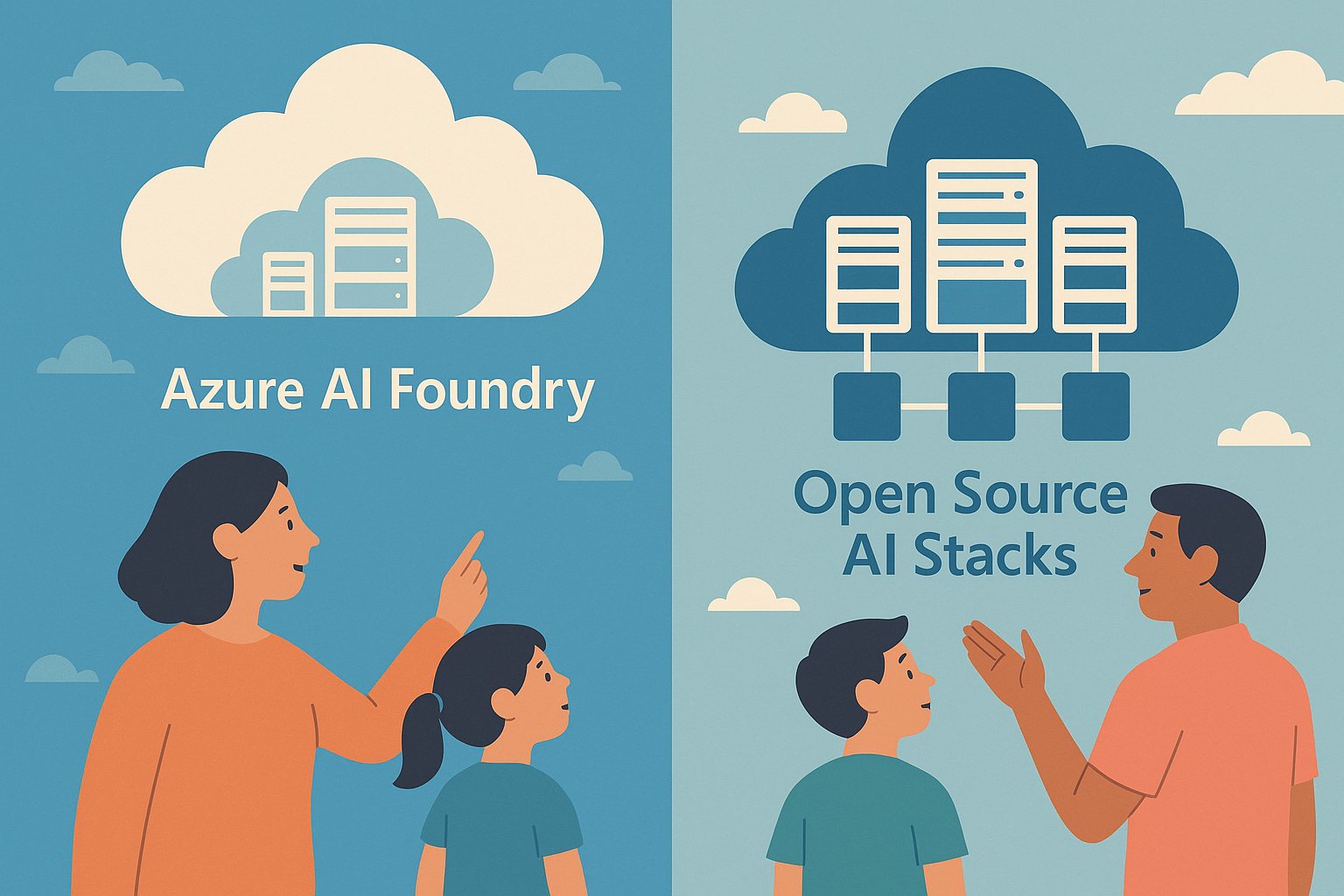
    Azure AI Foundry vs Open Source Stacks: Which Path Fits Better in 2026?

    Teams choosing an AI platform in 2026 usually face the same tradeoff: managed convenience versus open-source control. Neither path is automatically better.

    Choose Azure AI Foundry When

    • You want faster enterprise rollout
    • You need built-in governance and integration
    • Your team prefers less platform maintenance

    Choose Open Source When

    • You need deeper model and infrastructure control
    • You want portability across clouds
    • You can support the operational complexity

    The Real Decision

    The right answer depends less on ideology and more on internal skills, compliance needs, and how much platform ownership your team can realistically handle.

  • RAG Evaluation in 2026: The Metrics That Actually Matter

    RAG Evaluation in 2026: The Metrics That Actually Matter

    RAG systems fail when teams evaluate them with vague gut feelings instead of repeatable metrics. In 2026, strong teams treat retrieval and answer quality as measurable engineering work.

    The Core Metrics to Track

    • Retrieval precision
    • Retrieval recall
    • Answer groundedness
    • Task completion rate
    • Cost per successful answer

    Why Groundedness Matters

    A polished answer is not enough. If the answer is not supported by the retrieved context, it should not pass evaluation.

    Build a Stable Test Set

    Create a fixed benchmark set from real user questions. Review it regularly, but avoid changing it so often that you lose trend visibility.

    Final Takeaway

    The best RAG teams in 2026 do not just improve prompts. They improve measured retrieval quality and prove the system is getting better over time.

  • Why Small Language Models Are Winning More Real-World Workloads in 2026

    Why Small Language Models Are Winning More Real-World Workloads in 2026

    For a while, the industry conversation centered on the biggest possible models. In 2026, that story is changing. Small language models are winning more real-world workloads because they are cheaper, faster, easier to deploy, and often good enough for the job.

    Why Smaller Models Are Getting More Attention

    Teams are under pressure to reduce latency, lower inference costs, and keep more workloads private. That makes smaller models attractive for internal tools, edge devices, and high-volume automation.

    1) Lower Cost per Task

    For summarization, classification, extraction, and structured transformations, smaller models can handle huge request volumes without blowing up the budget.

    2) Better Latency

    Fast responses matter. In customer support tools, coding assistants, and device-side helpers, a quick answer often beats a slightly smarter but slower one.

    3) Easier On-Device and Private Deployment

    Smaller models are easier to run on laptops, workstations, and edge hardware. That makes them useful for privacy-sensitive workflows where data should stay local.

    4) More Predictable Scaling

    If your workload spikes, smaller models are usually easier to scale horizontally. This matters for products that need stable performance under load.

    Where Large Models Still Win

    • Complex multi-step reasoning
    • Hard coding and debugging tasks
    • Advanced research synthesis
    • High-stakes writing where nuance matters

    The smart move is not picking one camp forever. It is matching the model size to the business task.

    Final Takeaway

    In 2026, many teams are discovering that the best AI system is not the biggest one. It is the one that is fast, affordable, and dependable enough to use every day.

  • Azure Landing Zone Mistakes to Avoid in 2026

    Azure Landing Zone Mistakes to Avoid in 2026

    Landing zones are supposed to make cloud operations safer and cleaner. Poor setup does the opposite.

    1) Mixing Dev and Prod Controls

    Using the same policies and subscription boundaries for all environments creates risk and slows teams.

    2) Weak Identity Boundaries

    Overly broad role assignments remain one of the most common root causes of avoidable incidents.

    3) No Budget and Policy Guardrails

    Without enforceable cost and compliance controls, sprawl grows faster than governance.

    4) Logging Without Ownership

    Collecting logs is not enough. Teams need clear ownership for alert triage and response SLAs.

    5) Skipping Periodic Reviews

    Landing zones are not one-time projects. Review identity, networking, policy drift, and spend monthly.

    Final Takeaway

    A strong landing zone is an operating model, not a diagram. Keep controls clear, measurable, and regularly reviewed.

  • Multi-Agent Workflows in 2026: When to Use One Agent vs Many

    Multi-Agent Workflows in 2026: When to Use One Agent vs Many

    Teams are racing to adopt multi-agent systems, but more agents do not automatically mean better outcomes.

    In practice, many workloads perform best with a single well-scoped agent plus strong tools.

    Use One Agent When

    • The task is linear and has a clear start-to-finish flow.
    • You need predictable behavior and fast debugging.
    • Latency and cost are major constraints.

    Use Multiple Agents When

    • The task has distinct specialist domains (research, analysis, writing, QA).
    • Parallel execution creates real time savings.
    • You can enforce clear ownership and handoff rules.

    Common Failure Pattern

    Many teams split work into too many agents too early. That adds coordination overhead and raises failure rates.

    Practical Design Rule

    Start with one agent. Add specialists only when you can prove bottlenecks with metrics.

    Final Takeaway

    The best architecture is the simplest one that meets quality, speed, and reliability targets.

  • Azure Cost Optimization in 2026: 10 Moves That Actually Lower Spend

    Azure Cost Optimization in 2026: 10 Moves That Actually Lower Spend

    Most Azure cost reduction advice sounds good in a slide deck but fails in the real world. The moves below are the ones teams actually sustain.

    1) Fix Idle Compute First

    Start with VMs, AKS node pools, and App Service plans that run 24/7 without business need. Rightsize or schedule them off outside active hours.

    2) Use Reservations for Stable Workloads

    If usage is predictable, reserved capacity usually beats pay-as-you-go pricing by a large margin.

    3) Move Burst Jobs to Spot Where Safe

    CI pipelines, batch transforms, and non-critical workers can often run on spot capacity. Just design for interruption.

    4) Set Budget Alerts by Team

    Global budgets are useful, but team-level budgets create accountability and faster correction loops.

    5) Enforce Tagging Policy

    No owner tag means no deployment. You cannot optimize what you cannot attribute.

    6) Review Storage Tiers Monthly

    Blob, backup, and snapshot growth quietly becomes a major bill line. Archive cold data and remove stale copies.

    7) Cap Log and Telemetry Retention

    Observability is critical, but unlimited retention is expensive. Keep high-detail logs short, summarize for long-term trend analysis.

    8) Optimize Data Egress Paths

    Cross-region and internet egress costs add up quickly. Keep chatty services close together whenever possible.

    9) Add Cost Checks to Pull Requests

    Treat cost like performance or security. Catch expensive architecture changes before they hit production.

    10) Run a Weekly FinOps Review

    A short weekly review of anomalies, top spenders, and planned changes prevents surprise bills.

    Final Takeaway

    In 2026, strong Azure cost control comes from consistent operations, not one-time cleanup. Small weekly corrections beat quarterly fire drills.

  • AI Agents in 2026: What Actually Works in Production

    AI agents are improving fast, but many teams still struggle to move from a flashy demo to a dependable production system.

    The good news is that a few practical patterns consistently work.

    What Works in Production

    1) Keep the Scope Narrow

    Agents that do one business task well usually beat general-purpose bots that try to do everything.

    2) Add Human Checkpoints for Risky Actions

    Use approval gates for external actions such as purchases, account changes, and public publishing.

    3) Prioritize Retrieval Quality Over Model Size

    If your source data is outdated or noisy, even stronger models will produce weak outcomes.

    4) Measure Everything

    Track tool calls, latency, error rates, and cost per successful task. If you cannot measure it, you cannot improve it.

    5) Start Workflow-First, Then Add Autonomy

    Build reliable workflows first. Then add selective agent decision-making where it creates clear value.

    A Practical 30-Day Plan

    • Pick one high-value process.
    • Define success metrics before launch.
    • Pilot for 30 days with clear guardrails.
    • Review results weekly and tighten failure handling.

    Final Takeaway

    In 2026, winning agent strategies are not about maximum autonomy. They are about dependable execution, clear guardrails, and measurable business outcomes.

  • TLS Everywhere: Terminate at Edge or Pass Through?

    The decision

    You’re not deciding whether to use TLS. You are deciding where TLS starts and ends in your stack, and how many times traffic gets decrypted and re-encrypted along the way.

    The practical fork most teams hit looks like this:

    • Edge termination: TLS is terminated at a load balancer/ingress/API gateway, and traffic to backends may be plain HTTP or “internal TLS” depending on your setup.
    • End-to-end (pass-through / mTLS to the service): TLS stays encrypted all the way to the workload (and often uses mutual TLS between services).

    Both can be “secure.” The real question is which approach matches your threat model, compliance needs, operational maturity, and performance/observability requirements.

    What actually matters

    1) Your trust boundary
    If your “internal network” is truly trusted (single-tenant, locked down, strong segmentation, minimal lateral movement risk), edge termination may be acceptable. If you treat the internal network as hostile (multi-tenant, shared clusters, frequent third-party integrations, or strong lateral-movement concerns), you’ll want encryption beyond the edge.

    2) Identity and authentication between services
    TLS encryption alone is about confidentiality/integrity. The big upgrade is authenticated service identity (often via mTLS) so service A can prove it’s service A to service B. If you need strong service-to-service authentication and policy enforcement, you’re in “end-to-end + mTLS” territory.

    3) Operational complexity
    Certificates expire, CAs rotate, cipher policies change, and debugging gets harder when everything is encrypted. The more hops you encrypt, the more tooling you need for issuance, rotation, and incident response.

    4) Observability and traffic control
    If you decrypt at the edge, you can do WAF rules, request routing, rate limiting, header normalization, and detailed L7 metrics in one place. With TLS pass-through, you either:

    • move those capabilities to the service layer, or
    • use sidecars/service mesh/proxies that can still enforce policy while maintaining mTLS between hops.

    5) Compliance and audit expectations
    Many standards say “encrypt in transit,” but auditors often care about whether internal traffic is encrypted too, especially in cloud and container environments. If your environment is shared or regulated, assume you’ll be asked, “Is traffic encrypted between services?”

    Quick verdict

    Default for most teams: terminate TLS at the edge and encrypt service-to-service traffic where the internal network is not clearly trusted. Practically, that means edge TLS termination plus internal TLS for sensitive paths, and a plan to move to mTLS if service identity/policy becomes a first-class requirement.

    If you can only do one thing well today, do edge termination with strong hygiene (modern TLS config, HSTS where appropriate, solid certificate automation, and no plaintext across untrusted links). Then expand inward.

    Choose edge termination if… / Choose end-to-end (mTLS) if…

    Choose edge termination if…

    • You need simple, centralized ops: one place to manage certs, ciphers, and renewals.
    • You rely on L7 features at the perimeter: WAF, bot/rate controls, request routing, header manipulation, auth offload.
    • Your backend network is tightly controlled and you have strong segmentation, minimal east-west exposure, and clear ownership.
    • You have legacy services that don’t handle TLS well and you need a pragmatic path to modernization.
    • You need to inspect requests for security/abuse and are not ready to push that logic into each service.

    Choose end-to-end TLS (often mTLS) if…

    • You don’t fully trust the internal network: shared clusters, multi-tenant environments, or meaningful lateral-movement risk.
    • You need service identity and authorization: “only service X can call service Y” enforced cryptographically.
    • You have strict compliance expectations that treat internal traffic like external traffic (common in regulated orgs and cloud-native setups).
    • You’re building a zero-trust posture and want consistent security guarantees across every hop.
    • You already operate a mesh/PKI automation (or have the maturity to do it) so cert rotation is not a fire drill.

    Gotchas and hidden costs

    “Internal HTTP is fine” is often a temporary story. It tends to sprawl. New services get added, traffic patterns change, and suddenly you have plaintext in places you didn’t intend (cross-zone, cross-cluster, partner links, backups, observability pipelines).

    Certificate lifecycle becomes an ops dependency. End-to-end TLS without automation is brittle. Expired certs are one of the most common self-inflicted outages. If you go beyond edge termination, invest early in:

    • automated issuance and renewal (ACME or an internal CA workflow),
    • short-lived certs where feasible (reduces blast radius),
    • clear ownership for CA rotation, and
    • alerting on expiry and handshake errors.

    Observability can get worse before it gets better. With more encryption, packet captures and mid-stream inspection are less useful. Plan for:

    • structured application logs with request IDs,
    • distributed tracing propagated end-to-end,
    • metrics on handshake failures, latency, and error codes at every hop.

    Performance isn’t free, but it’s rarely the blocker. TLS handshakes and encryption add CPU and latency, especially with high connection churn. Mitigations include connection pooling/keep-alives, HTTP/2 or HTTP/3 where appropriate, and avoiding unnecessary re-encryption hops. Don’t guess—measure in your environment.

    Termination points are policy choke points. If you terminate at the edge and forward plaintext, any compromise in the internal path can expose data. If you terminate multiple times (edge, then sidecar, then service), each termination is also a potential misconfiguration point. Reduce the number of decrypt/re-encrypt steps unless you get clear value from each one.

    mTLS can create a false sense of security. It authenticates endpoints, but it doesn’t fix broken authZ logic, insecure APIs, or over-broad service permissions. You still need least-privilege policies, good identity mapping, and sane defaults.

    How to switch later

    If you start with edge termination, avoid painting yourself into a corner:

    • Keep backends capable of TLS even if they’re not using it on day one. Make “TLS-ready” a baseline requirement for new services.
    • Standardize on HTTP semantics (headers, timeouts, retries) so introducing a proxy/sidecar later doesn’t break everything.
    • Don’t bake client IP assumptions into auth. TLS termination and proxying change what “client IP” means; rely on validated headers (set only by trusted proxies) and signed tokens for identity.
    • Introduce internal TLS on the highest-risk links first: cross-datacenter/zone links, traffic carrying secrets/PII, and any path that crosses a shared boundary.

    If you start with end-to-end/mTLS, keep it maintainable:

    • Choose one certificate authority strategy and document it. Multiple overlapping PKIs become a debugging nightmare.
    • Make rotation routine (frequent, automated, tested) so CA changes aren’t a once-a-year outage event.
    • Have a break-glass mode for incidents: the ability to temporarily relax strictness (in a controlled way) can reduce downtime when cert plumbing fails.

    My default

    Default: terminate TLS at the edge, and plan for internal encryption as you scale. Specifically:

    • Edge TLS termination with strong defaults (modern protocols/ciphers, automated renewals, HSTS where appropriate).
    • Encrypt any traffic that crosses an untrusted boundary (between clusters, zones, accounts, VPCs, or anything you don’t fully control).
    • Adopt mTLS when service identity and policy become requirements—not as a checkbox, but because you need authenticated, least-privilege service-to-service communication.

    This approach gives most teams the best security-to-complexity ratio: you get real risk reduction quickly, while keeping a clean path to end-to-end guarantees when your architecture (and your org) is ready for it.